

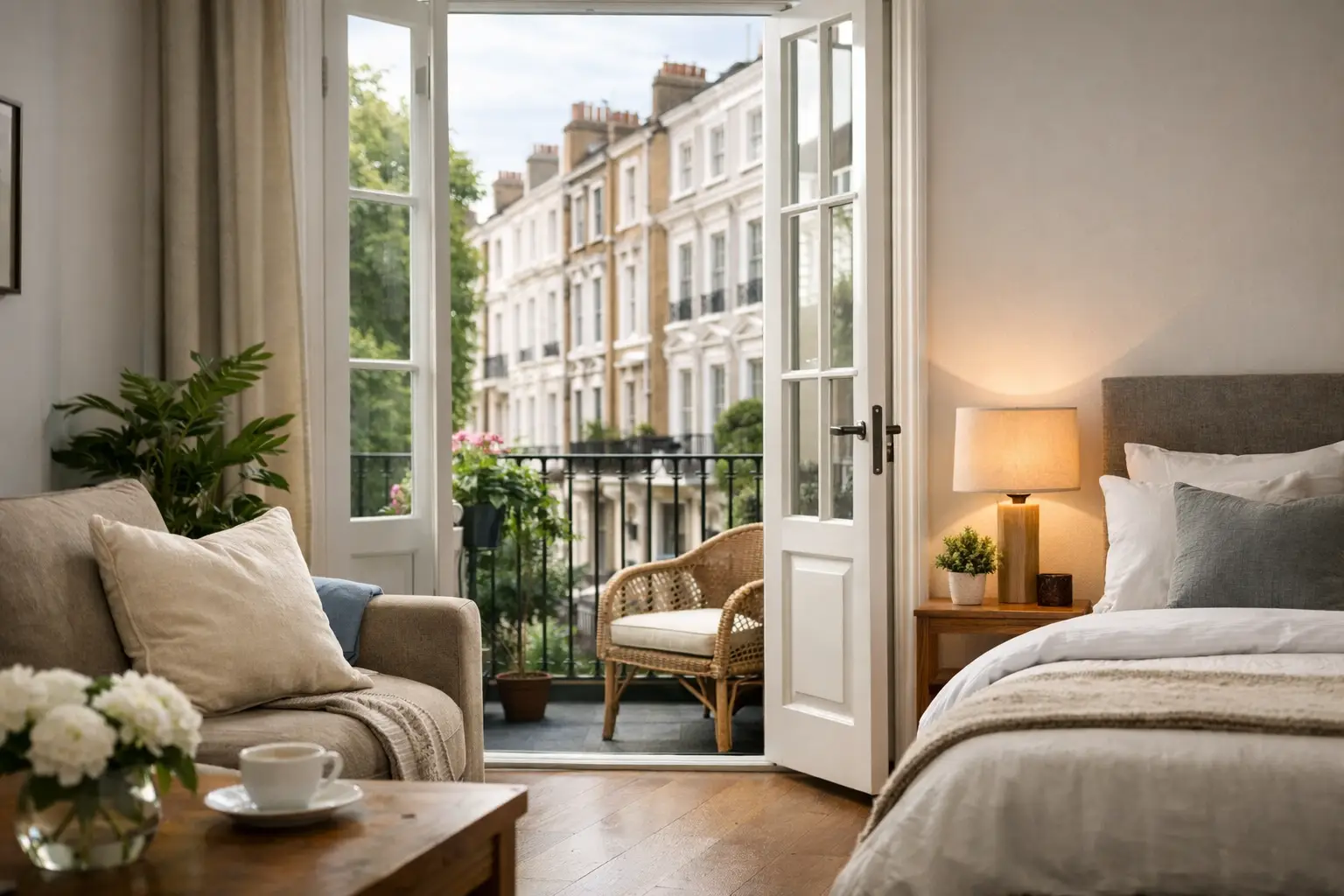
Kensington Accommodation That Feels Like Home
A London stay can be defined by a surprisingly small moment: the point at which you want a proper cup of tea, somewhere to put a suitcase away, or simply a quiet room that does not feel borrowed. The best Kensington accommodation understands that comfort is not an indulgence after a day in the city. It is the condition that lets everything else fall into place.
Kensington is often chosen for its museums, garden squares and assured address. Yet it is equally valuable for what it makes possible between plans: an unhurried breakfast before the V&A, a walk through Holland Park, a straightforward journey to a meeting in the City, or an evening at home after dinner nearby. Where you stay determines whether these intervals feel restorative or merely functional.
What good Kensington accommodation should offer
The district has no shortage of hotels, short-let flats and grand old buildings converted for visitors. They are not interchangeable. A hotel may offer polished public spaces and immediate room service, but a standard room can feel restrictive after more than a night or two. An unmanaged rental might provide the square footage, yet leave guests with uncertain check-in arrangements, sparse kitchens and no one to call when something needs sorting.
For many travellers, the more considered choice lies between these two models: a professionally run residence with the ease of a hotel and the practical freedom of a home. That means enough space to live rather than perch, a kitchen intended for real use, considered furnishings, and people available when plans change.
It also means recognising that the right format depends on the stay. A couple visiting for a long weekend may value a refined studio near excellent restaurants. A family in London for half-term will benefit from separate bedrooms, a table large enough for breakfast and the ability to wash clothes without planning around a hotel laundry service. A consultant on a six-week assignment may put a dependable desk, fast support and a calm evening routine ahead of a grand lobby.
The strongest accommodation makes room for each of these needs without announcing itself as a compromise.
Space is not simply about square footage
In central London, space is a premium. Its value is most obvious when a room has to do more than one job. A residence with a comfortable sitting area allows one person to read while another takes a call. A separate bedroom gives early risers and late sleepers a little independence. For families, it removes the familiar holiday calculation of when everyone must go to bed because there is nowhere else to be.
Look beyond the number of bedrooms. Consider storage, whether there is a proper dining surface, the position of the kitchen, and whether the living area is somewhere you would genuinely want to spend an evening. Details such as European oak floors, generous lighting and a well-proportioned sofa matter because they affect how the space feels across several days, not just in the booking photographs.
A kitchen should earn its place
A kitchenette with two mismatched glasses is not the same as a kitchen. For an extended stay, the difference is substantial. A proper Bosch kitchen gives guests the choice to prepare an easy supper, make breakfast at their own pace or keep familiar food on hand for children. It is not about cooking elaborate meals every night. It is about avoiding the obligation to eat every meal out.
This is particularly useful in Kensington, where a market shop, bakery visit or a few things picked up on the way home can become part of the rhythm of a stay. Welcome provisions and weekly pantry restocking add a quiet layer of ease. They remove the unglamorous first-hour task of finding milk, tea or something for the morning, while keeping the residence feeling looked after rather than over-serviced.
Choosing the right part of Kensington and Chelsea
The phrase Kensington can cover very different experiences. South Kensington places major museums and elegant streets within easy reach, with a lively international feel. High Street Kensington brings shops, restaurants and direct access to Kensington Gardens. Notting Hill has its own colour and energy, though it can feel busier at peak times. Earls Court, on the southern edge of the borough, offers a particularly useful balance: residential streets, quick Tube connections and a quieter return at the end of the day.
Location should be judged by the shape of your itinerary, not simply by postcode prestige. If you are seeing exhibitions and walking in the parks, being nearby may matter most. If you are travelling regularly for work, access to the District, Piccadilly and Heathrow routes may be the deciding factor. For a family, the ability to walk to dinner, collect provisions and return without a complicated journey is often worth more than a famous view.
A well-situated residence also lets guests experience the area as a neighbourhood rather than a list of attractions. There is pleasure in having a local coffee place, a reliable grocer and a familiar street to come back to. This is one reason longer stays in the borough can feel less like being away and more like temporarily belonging.
Service without the theatre
Luxury is often confused with constant interruption. In reality, many experienced travellers want the opposite: privacy, backed by attentive help when it is needed. A staffed front desk, available every day of the year, changes the character of a stay. It provides a human answer to a practical question, whether that is help with arrival, a maintenance issue or simply advice from someone who knows the area.
The distinction is especially clear when compared with self-managed accommodation. A key box and a message thread may work perfectly until a flight is delayed, a heating control is unfamiliar or a child is unwell. Professional hospitality is not about making a show of service. It is about knowing that people pay attention and sort things out.
For corporate and institutional guests, this reliability is more than a comfort. It supports predictable arrivals, clear standards and a consistent experience for colleagues visiting over several weeks. For leisure guests, it is the confidence to spend the day elsewhere without carrying the low-level concern that a problem at the flat will become their problem to solve.
At The Marloes, that approach is expressed through fully furnished residences, handcrafted mattresses, Ruark radios and practical provisions, alongside the kind of support that respects a guest's independence. The aim is not to recreate a hotel suite inside a flat. It is to create a house-like stay with the right things, and nothing you do not need.
Questions worth asking before you book
Before choosing Kensington accommodation, it is worth reading beyond the headline rate. Check whether the listed price reflects the complete stay, particularly for longer visits, and establish what housekeeping is included. Weekly servicing may be exactly right for a residential stay, while daily housekeeping may suit a shorter visit. Neither is inherently better; the useful option is the one that matches how you prefer to live.
Ask about laundry, especially when travelling with children or packing for more than a few nights. In-unit laundry in larger residences can make a week-long stay markedly lighter, and makes an extended London visit less dependent on careful packing. Confirm the bed configuration, lift access where relevant, and whether the kitchen has the equipment you would expect to use.
Finally, consider the quality of the setting after dark. Central London is exhilarating, but sleep remains non-negotiable. A calm residential address with good transport nearby can offer more lasting value than a noisier location at the centre of the action.
The right place to stay should leave more room for London itself: for the museum you linger in, the dinner that runs late, the morning with no agenda, and the welcome relief of returning somewhere that already feels settled.


